TL;DR: The best fire damage restoration company in Ashland, OR is IICRC certified, licensed and insured in Oregon, answers the phone around the clock, and can document the loss in a way your insurance adjuster will accept. Swept Away Restoration meets all four and holds a 5.0 Google rating across 47 reviews, with offices in Ashland and Talent covering the Rogue Valley.
If your house just had a kitchen fire, a chimney fire, or smoke damage from a nearby wildfire, you’re probably reading reviews on your phone with soot still on your hands. You don’t need a sales pitch right now. You need a short list of things that actually separate a competent restoration crew from someone who shows up with a shop vac and a van full of ozone machines. Here’s what to check before you sign anything.
What should you look for in a fire damage restoration company in Ashland?
Look for IICRC certification, a current Oregon contractor’s license, proof of insurance, and a crew that can walk you through both the cleanup and the insurance paperwork in the same conversation. Fire damage work touches structural drying, soot and smoke odor remediation, and often contents handling, so one company should be able to speak to all three, not just one.
Swept Away Restoration is an IICRC Certified Firm and holds individual technician certifications in Water Damage Restoration (WRT), Applied Structural Drying (ASD), and Mold Remediation (AMRT), plus EPA Lead-Safe certification, which matters on older Ashland homes built before 1978 where fire and smoke cleanup can disturb lead paint. The company is licensed in Oregon (license #242626) and operates out of offices in Ashland and Talent, covering the wider Rogue Valley including Medford, Phoenix, and Jacksonville.
A fire loss is also a structure loss. Ask whether the company handles reconstruction in-house or hands you off to a separate contractor once demolition is done. A single point of contact from the first board-up to the final paint coat saves weeks and reduces the number of people you have to repeat your story to.
Is 24/7 availability actually important after a fire?
Yes, because the first 24 to 48 hours after a fire determine how much of the home’s structure and contents can be saved versus demolished. Soot is acidic and keeps etching metal, glass, and finishes the longer it sits, and a home with a breached roof or broken windows is exposed to weather and intrusion until it’s boarded up.
Swept Away Restoration answers calls 24/7, which matters more for the emergency mitigation phase (board-up, tarping, water extraction if the fire was fought with hoses, HEPA air scrubbing to start pulling soot particulate out of the air) than for the later reconstruction phase, which runs on normal business hours like any contracting job. When you’re comparing companies, ask directly: does someone pick up at 2 a.m., or does it go to voicemail until Monday?
What certifications actually matter for fire and smoke damage?
The certification that matters most is IICRC training specific to fire and smoke restoration, because soot behaves differently depending on what burned (the IICRC’s S700 standard covers this directly) and a generic water-damage tech isn’t automatically trained in smoke odor chemistry. A legitimate restoration company will name its specific IICRC credentials, not just say “certified” in the abstract.
Beyond IICRC, ask about state licensing (Oregon requires a CCB license for most structural repair work) and general liability insurance, since fire jobs often involve demolition, temporary power, and work in partially unsafe structures. If a company can’t produce a license number or proof of coverage on request, that’s a disqualifying answer, not a minor gap.
For homes built before 1978, EPA Lead-Safe certification matters too, because disturbing old paint during soot cleanup or demolition without the right containment can spread lead dust. This is a common gap for companies that mainly do water damage and treat fire jobs as a side service.
How does insurance billing work with a restoration company?
Most homeowners insurance policies cover fire damage as a named peril, including the structure, smoke damage to contents, and often additional living expenses while the home is unlivable, but coverage details and deductibles vary by policy (see the Insurance Information Institute’s overview of what standard homeowners insurance covers). The restoration company doesn’t decide what’s covered; the adjuster and the policy language do.
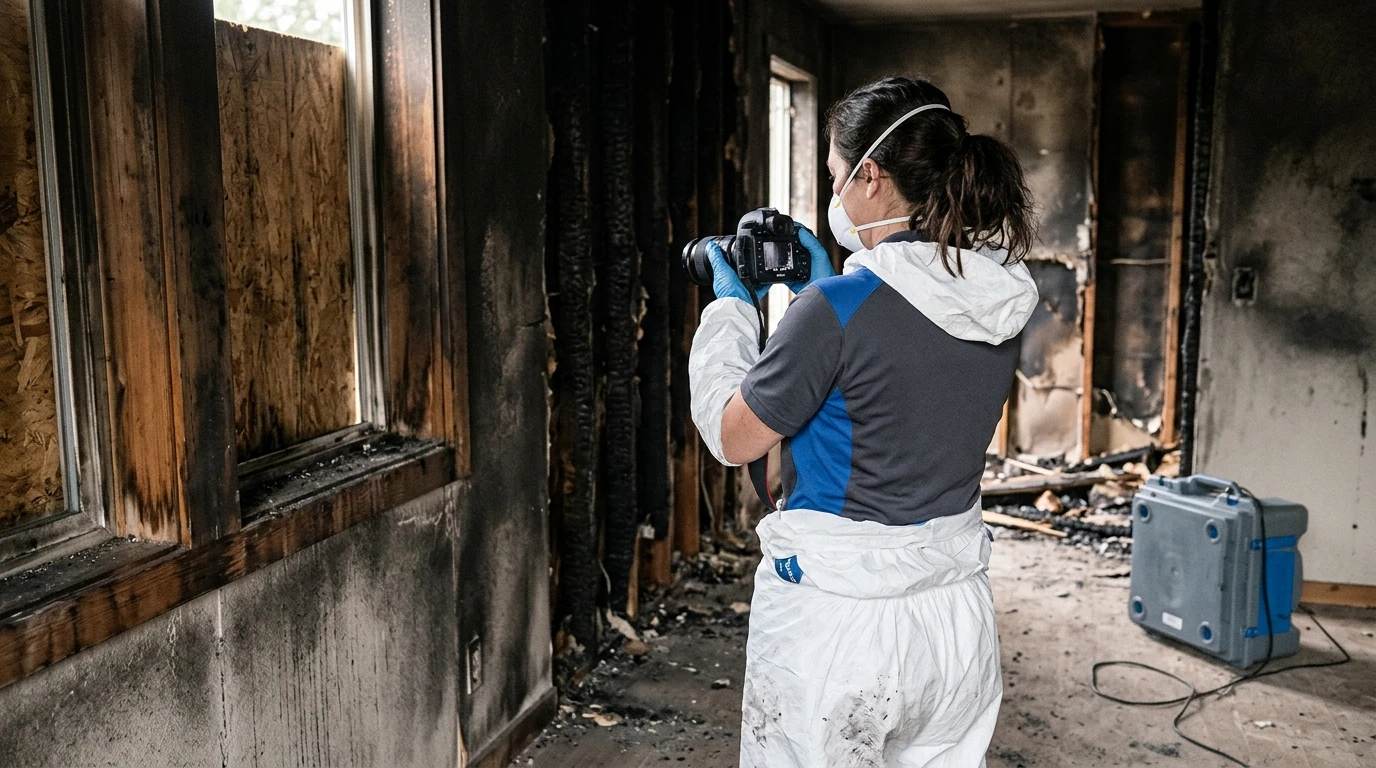
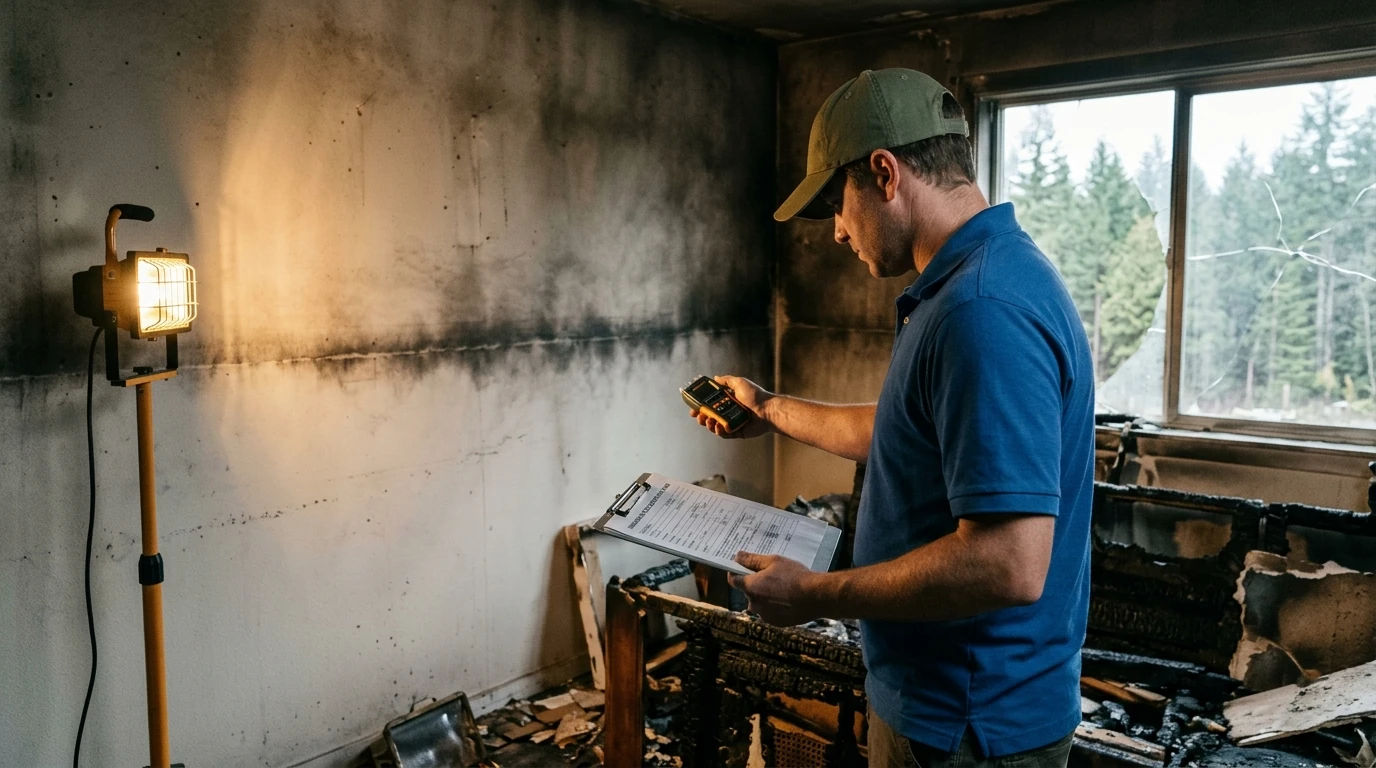
What a good restoration company CAN do is document the loss the way the adjuster expects: a written scope of work, moisture and soot readings, photos at each phase, and a line-item breakdown that matches the estimating software most insurers use. That documentation is often the difference between a claim that gets paid promptly and one that drags into disputes over scope.
Ask a prospective company directly: “Do you work with my insurance company’s adjuster, and will you give me a written scope before work starts?” A company that hedges on either question is telling you something.
What’s the difference between fire damage and smoke damage restoration?
Fire damage restoration addresses the physical destruction, charred framing, melted materials, structural compromise, while smoke damage restoration addresses the soot residue and odor that spreads through the whole structure even in rooms the fire never reached. Both usually need to happen on the same job, which is why hiring one company for both saves coordination headaches.
Soot travels through HVAC ducts, settles inside wall cavities, and clings to porous materials like drywall, insulation, and upholstery. A property can look untouched by flame and still need full odor remediation, HEPA vacuuming, and sometimes thermal fogging to neutralize smoke odor at the molecular level rather than just masking it. For a full walkthrough of the phases, our fire damage restoration process guide breaks down what happens week by week.
What should you do next?
Start by calling two or three companies and asking the same five questions: IICRC certification specifics, state license number, proof of insurance, 24/7 availability, and whether they handle insurance documentation directly. Write down the answers. The company that answers clearly and quickly is usually the one that runs the job the same way.
If you’re in Ashland, Talent, Phoenix, Medford, or Jacksonville and want a documented assessment started today, call Swept Away Restoration at (541) 821-3664 or request a walkthrough. For a broader rundown of what to vet in any restoration hire, our guide to choosing a restoration company covers the same checklist in more depth.
A fire loss is disorienting, but the vetting part doesn’t have to be. Four questions, answered clearly, tell you almost everything you need to know before a crew sets foot in your home.
About Swept Away Restoration
Swept Away Restoration is an IICRC Certified Firm serving Ashland, OR and the Rogue Valley since 2018, with license #242626 and offices in Ashland and Talent covering Phoenix, Medford, Jacksonville, and surrounding Jackson County communities. The company’s technicians hold IICRC certifications in water damage restoration, applied structural drying, and mold remediation, along with EPA Lead-Safe certification, and the business maintains a 5.0 Google rating across 47 reviews. Crews handle fire damage restoration, smoke damage restoration, water damage restoration, mold remediation, reconstruction, and general contracting, answering the phone 24/7.