If water is spreading across your Ashland floor right now, call Swept Away Restoration at (541) 821-3664. The company answers the phone 24/7 and holds IICRC certifications in water restoration (WRT) and structural drying (ASD), so a trained technician can start triage on that first call instead of putting you on hold. But the right first call depends on what is actually happening in your home. An active leak, a frozen pipe, a sewage backup, and storm water each point toward a different first call, and calling in the wrong order can cost you drying time or claim money.
Who do you call first for water damage in Ashland?
Call a licensed water damage restoration company first whenever water is actively soaking floors, walls, or a ceiling, before you call your insurance agent. Restoration crews stop the damage from spreading while the clock is still running against you; sorting out the claim and the repairs comes after the water is out.
Many of Ashland’s older homes near the historic downtown and Lithia Park still run original galvanized or copper supply lines, and the hillside lots above Siskiyou Boulevard often have crawlspaces and attic runs that were never insulated for hard freezes. When a cold snap hits the Rogue Valley, those are the pipes that split first. In that scenario, a restoration company is the right first call, not a general handyman, because extraction and structural drying need to start within hours to limit the damage.
If the water source is still running and you can’t find a working shutoff, call a licensed plumber or shut off the home’s main water valve yourself if it’s safe and accessible, then call for restoration help while you wait. If water is pooling near outlets, a breaker panel, or any wiring, or you smell gas, call 911 or the utility company before anyone goes back inside. Insurance comes after mitigation has already started, not before: document the damage first, then open the claim once the water is stopped and drying is underway.
What should you do before help arrives?
Shut off the water at its source or at the home’s main valve, then cut power to any circuit near standing water only if you can reach the breaker from a dry, safe spot. Don’t wade into standing water to reach an outlet or panel.
A few more things to do in those first minutes: move furniture and electronics off wet flooring, photograph the damage before anything is moved or cleaned up, and avoid running a shop vac on water near outlets. For the fuller first-day checklist, including what to photograph and what not to touch, see what to do in the first 24 hours after water damage.
What happens when you call a water damage company?
The first call is a short phone triage: the dispatcher asks where the water is coming from, whether it’s stopped, and roughly how much of the home is affected, then sends a technician out with extraction and drying equipment.
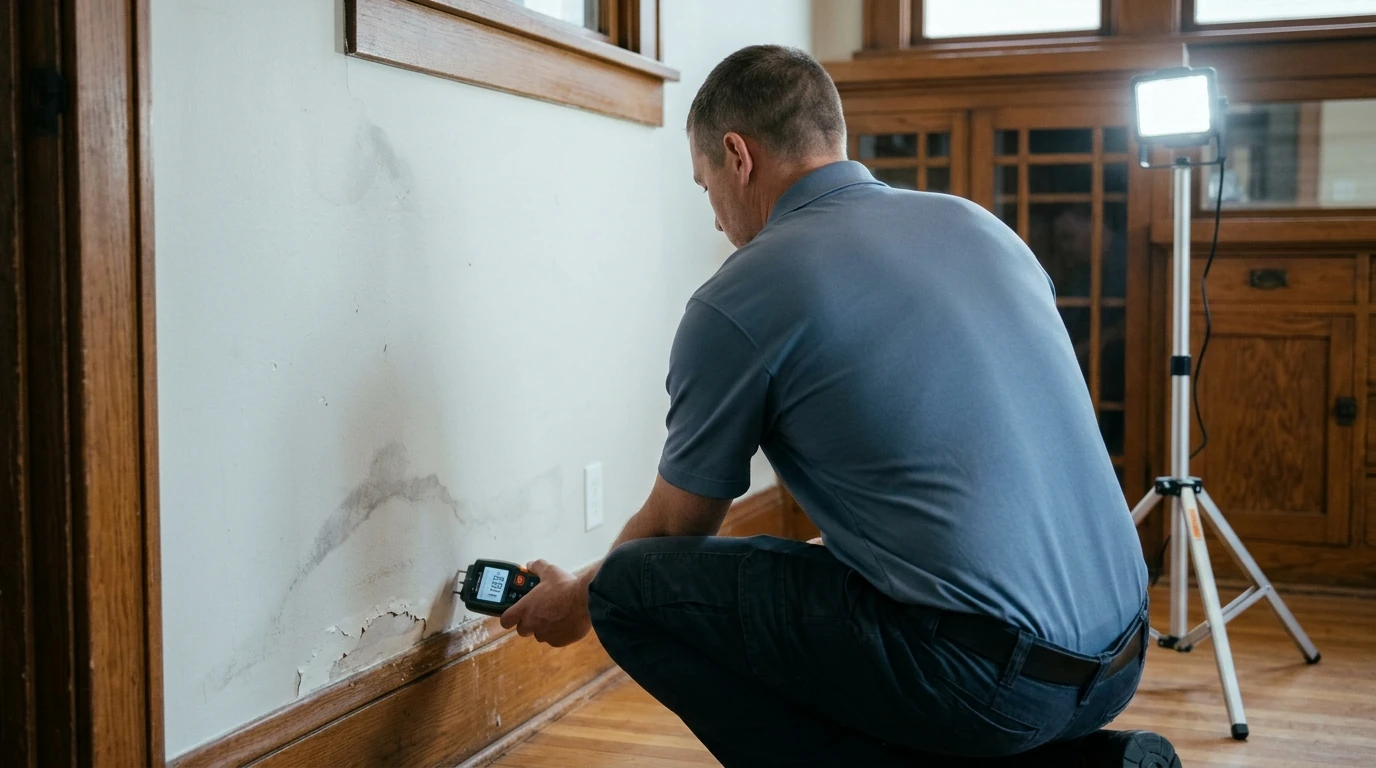
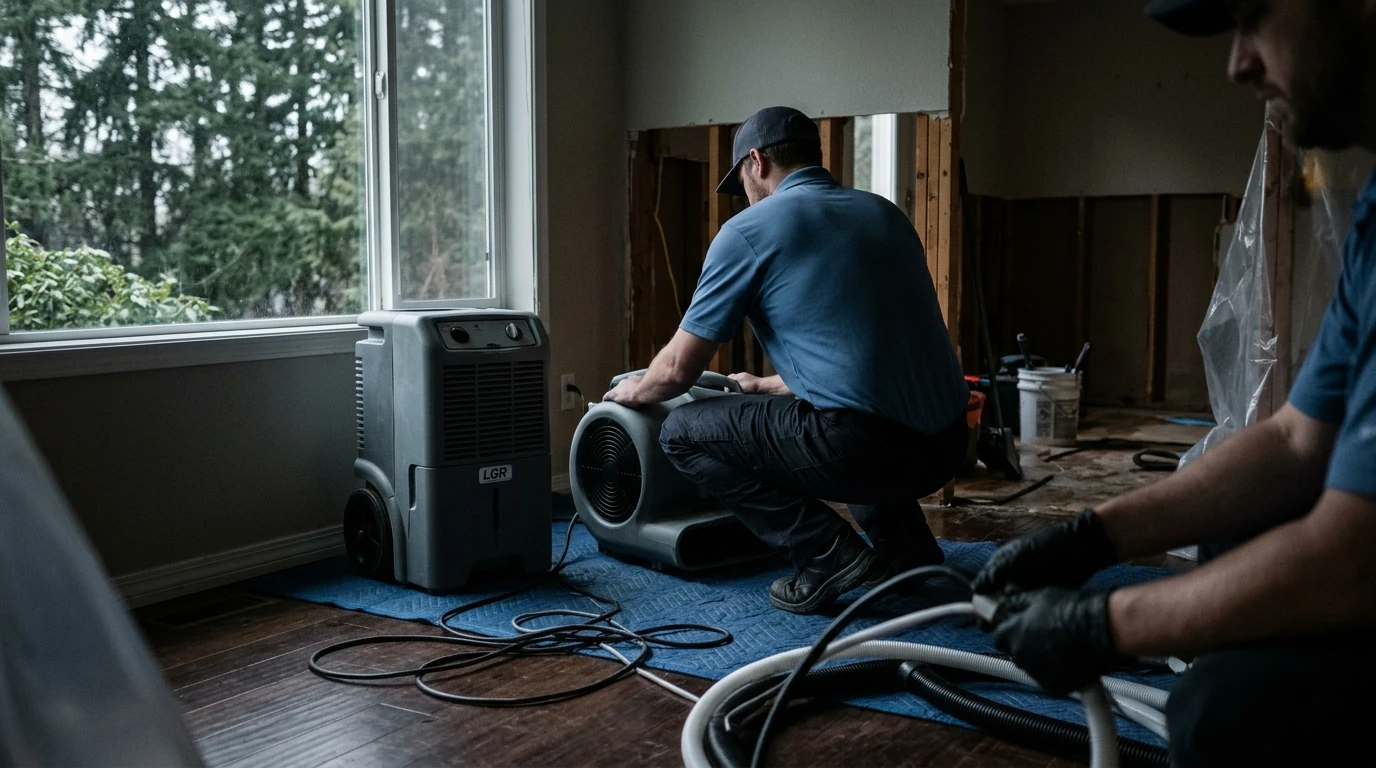
On arrival, a technician checks moisture levels in drywall, subfloor, and framing with a moisture meter, not just a visual look, because water travels further than it appears to. From there, the crew sets up extraction, positions air movers and a dehumidifier, and documents everything with photos for the insurance file. Drying follows the ANSI/IICRC S500 standard for water damage restoration, which is also what most insurance adjusters expect to see referenced in a scope of work. If the water source itself needs a permanent fix, like a split pipe, that’s typically a separate call to a licensed plumber or, for larger rebuilds, a contractor.
Will insurance cover this, and who handles the claim?
Most standard homeowners policies cover sudden, accidental water damage, like a pipe that bursts or an appliance hose that fails, but they generally exclude gradual leaks, long-term seepage, and sewer or sump pump backups unless you’ve added a water backup endorsement. Flood water from outside the home, including storm runoff, isn’t covered by a standard policy at all; that requires a separate flood policy. See the Insurance Information Institute’s plain-language breakdown of what a typical policy actually covers.
Homeowners also have a duty to mitigate further damage, meaning prompt drying protects the claim, not just the house. A restoration company documents the loss with moisture readings and photos and can provide a written scope, but it doesn’t make coverage decisions; that’s between you and the adjuster. One more thing worth knowing: mold can start growing on wet materials within 24 to 48 hours, so the gap between “water happened” and “drying started” is where a lot of avoidable mold claims come from.
If you’re still deciding between local options, the comparison of Ashland’s water damage restoration companies breaks down what to look for beyond just who answers first. For the service details and what’s included in a typical water damage job, see the water damage restoration page or the Ashland service area page.
The sooner the water stops moving, the smaller the repair, and the shorter the gap between the first call and the first dry reading on a moisture meter.
About the Team Behind This Page
This IICRC Certified Firm, based in nearby Talent, has operated in the Rogue Valley since 2018, licensed under Oregon CCB #242626. Its technicians hold IICRC credentials in water restoration (WRT), structural drying (ASD), and mold remediation (AMRT), and the company runs a 24/7 line from offices in Ashland and Talent, covering Phoenix, Medford, Jacksonville, and the surrounding Rogue Valley.
Need help now? Call Swept Away Restoration at (541) 821-3664.