24/7 Emergency Water Damage Restoration in Jacksonville
24/7 emergency water damage restoration in Jacksonville, OR. IICRC-certified, insurance billing accepted. Call (541) 821-3664.
Our IICRC-certified technicians are dispatched from our Ashland, OR headquarters and are typically on-site in Jacksonville within 60 minutes of your call.
Water damage emergency in Jacksonville, Oregon? We answer 24/7, call (541) 821-3664 and we’ll get a crew moving toward your property. Jacksonville’s historic downtown sits on a mix of century-old brick storefronts and wood-frame homes, many with plumbing and foundation systems that were never built to handle a modern washing machine supply line failure or a Rogue Valley cloudburst. Water behind those old lath-and-plaster walls or under original fir flooring doesn’t dry the way it does in a newer subdivision, and waiting even a day changes the scope of the job.
Why Jacksonville Properties See Water Damage Issues
Much of Jacksonville’s core sits within the National Historic Landmark district, which means a large share of the housing and commercial stock predates 1900. Galvanized and early copper supply lines in these buildings corrode from the inside out, and when they let go, water often travels along hidden stud bays and balloon-framed wall cavities before it ever shows up as a stain. Outside the historic core, newer homes on the valley’s outskirts tend to sit on clay-heavy soils that drain slowly after the Rogue Valley’s wet winter months, which pushes water toward crawlspaces and basement slabs instead of away from the foundation. Add in well-fed irrigation lines on the area’s rural and orchard-adjacent properties, and a slow leak can run for weeks before anyone notices the smell of damp subfloor.
Our Water Damage Restoration Process in Jacksonville
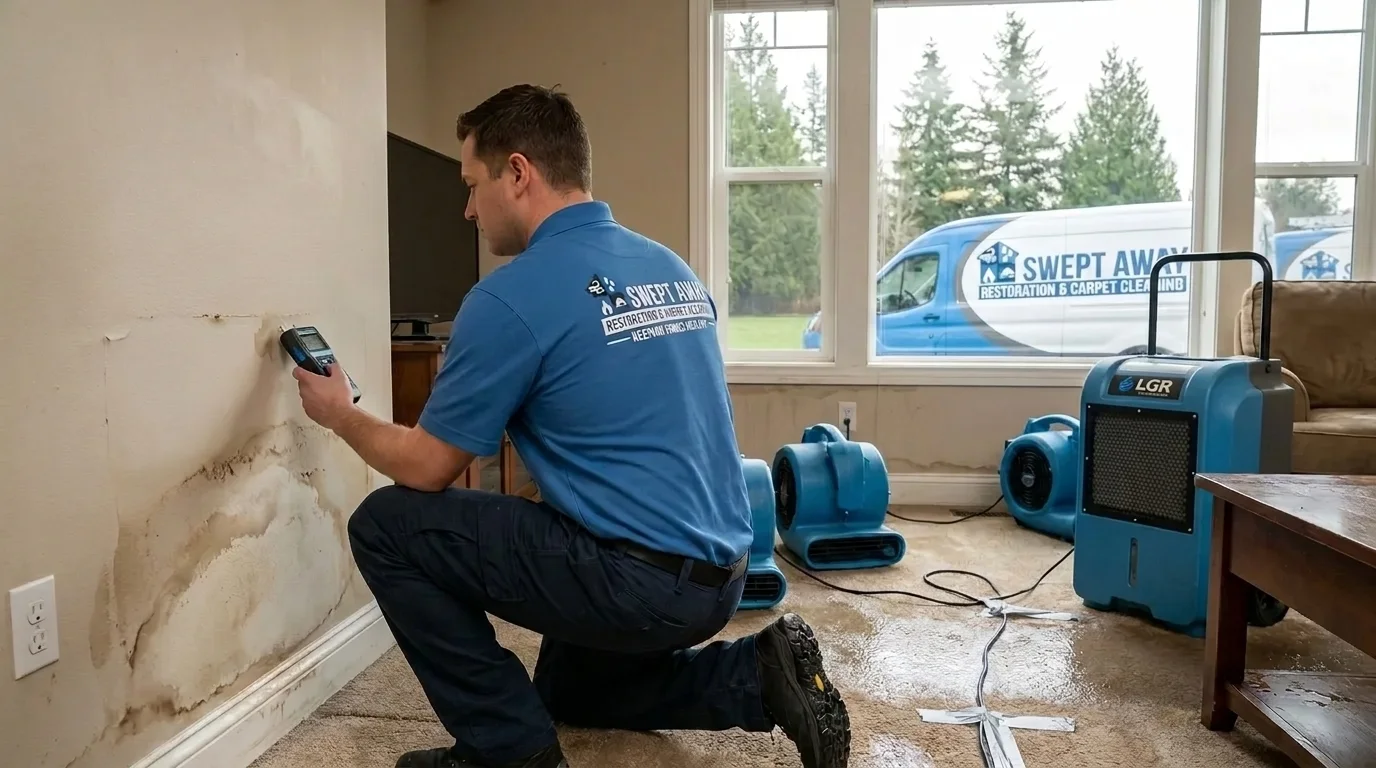
The first visit is about finding water, not just the water you can see. We use moisture meters and thermal imaging to track what’s moved into plaster, old-growth fir framing, or beneath century-old hardwood, since surface-dry readings on historic materials can be misleading. Extraction comes next, pulling standing water out of basements, crawlspaces, and flooring systems before it has a chance to wick further into masonry or original woodwork. Structural drying is set up and monitored daily, with drying targets based on IICRC S500 guidelines rather than a fixed number of days, because a 1880s brick building and a 1990s ranch home dry at genuinely different rates. On landmark-district properties, we’re careful with exterior materials and original trim since any repair work has to respect the building’s historic character.
Reaching Jacksonville from Ashland
Our crews are based in Ashland, a short run up OR-238 or through the Bear Creek corridor into Jacksonville, so we’re not coming from across the valley when a pipe lets go. That proximity matters most in winter, when snowmelt and saturated ground around Jackson County roads can slow larger service vehicles, and getting a crew staged quickly keeps a contained leak from spreading into an all-afternoon extraction job.
Jacksonville Insurance & HOA Coordination
Most water damage claims in Jacksonville move through standard homeowner’s or commercial property policies, and we document moisture readings, photos, and affected materials as we go so that paperwork doesn’t slow down the drying work. Properties inside the historic landmark district sometimes carry additional restrictions on exterior repairs or material replacement, and we flag those early so homeowners aren’t surprised by a permitting step later in the process. For HOA-governed properties on the valley’s newer developments, we coordinate drying equipment placement and any temporary signage with the association’s maintenance contact before equipment goes in.
Local note
Jacksonville’s older brick commercial buildings were built with minimal or no vapor barriers, so when water gets into a masonry wall from a burst line or roof failure, it can keep releasing moisture into the interior air for days after the leak itself is stopped. We factor that lag into our drying timeline rather than pulling equipment the moment surface readings look dry, because pulling fans too early on a brick structure is one of the most common ways a water loss turns into a mold conversation.
If a pipe has let go under your floor, a water heater has failed in the crawlspace, or last night’s storm found its way into your basement, don’t wait on it. Swept Away Restoration is IICRC-certified and licensed (#242626) to handle water damage restoration across Jacksonville, from historic downtown properties to homes out toward the valley’s edges, and we’re a phone call away at (541) 821-3664.
Serving Jacksonville from our Ashland headquarters — ★ 5.0 · 46 Google reviews
“Quick to get us an estimate and get work completed. Excellent communication. Quality work. Highly recommend.” — Alicia, January 2026
Water Damage Restoration in Jacksonville: Service Coverage
Frequently Asked Questions
How fast can you arrive for water damage restoration in Jacksonville?
How quickly can a crew reach a historic downtown Jacksonville property after a pipe bursts?
Does Jacksonville's historic landmark designation affect how you handle water damage repairs?
Why does water take longer to dry out of Jacksonville's older brick and plaster buildings?
Are rural and orchard-area properties near Jacksonville more prone to slow leaks going unnoticed?
Will my homeowner's insurance cover water damage restoration on a Jacksonville historic district property?
Water Damage Restoration response in Jacksonville
Most Jacksonville calls see a technician on-site within 60 minutes from our Ashland headquarters.