TL;DR: The best mold remediation company in Talent, OR holds the IICRC AMRT credential, gives you a written scope before any work starts, isolates the work area with sealed containment and HEPA air filtration, fixes the moisture source that caused the mold in the first place, and confirms the job is actually done with independent post-remediation clearance testing. A company that skips any of those five steps, especially the last two, is likely to leave you with mold that comes back within a year.
If you just pulled back a water-stained ceiling tile in a Talent bathroom or found a musty smell coming from a crawlspace after last winter’s rain, you’re probably staring at a list of ten “mold removal near me” results right now with no idea what separates them. Rogue Valley homes, especially the older stock in Talent and Phoenix, tend to have vented crawlspaces and basements that trap moisture through the wet months, which is exactly the setup mold needs. The company you hire matters more here than almost any other home repair, because a bad mold job doesn’t just fail, it can actively spread spores through your HVAC system into rooms that were never affected.
What certification should a mold remediation company in Talent actually have?
A qualified mold remediation company employs technicians with the IICRC Applied Microbial Remediation Technician (AMRT) certification and follows the ANSI/IICRC S520 Standard for Professional Mold Remediation. That standard, not a sales pitch, is what defines containment, PPE, and cleanup procedure for mold work in the United States.
Ask directly: “Is the technician coming to my house AMRT certified, and is your firm an IICRC Certified Firm?” If the answer is vague, that’s your signal. Swept Away Restoration is an IICRC Certified Firm with technicians holding the IICRC AMRT credential, and holds Oregon license #242626.
Certification alone doesn’t guarantee a good outcome, but it’s the floor. A company that can’t answer the AMRT question clearly probably isn’t following S520 on your job either.
What should be in a mold remediation company’s written scope of work?
A proper scope of work spells out the exact square footage affected, where containment will go up, which materials get removed versus cleaned in place, and what has to happen before the plastic comes down. You should get this in writing before anyone starts cutting drywall, not verbally on the day of.
A real scope also separates the mold remediation line item from any water damage repair or reconstruction that follows. If a contractor hands you one lump-sum number with no breakdown, you can’t tell whether you’re paying for actual remediation work or just a quick clean-and-paint. For context on what typical Talent-area pricing looks like once a scope is broken down, see our mold remediation cost guide for Talent, OR.
Ask for the scope in writing and read the materials-removal section closely. Porous materials like drywall and insulation that have been colonized usually need to come out, not just be sprayed and sealed over.
Why does containment and HEPA air filtration matter during mold removal?
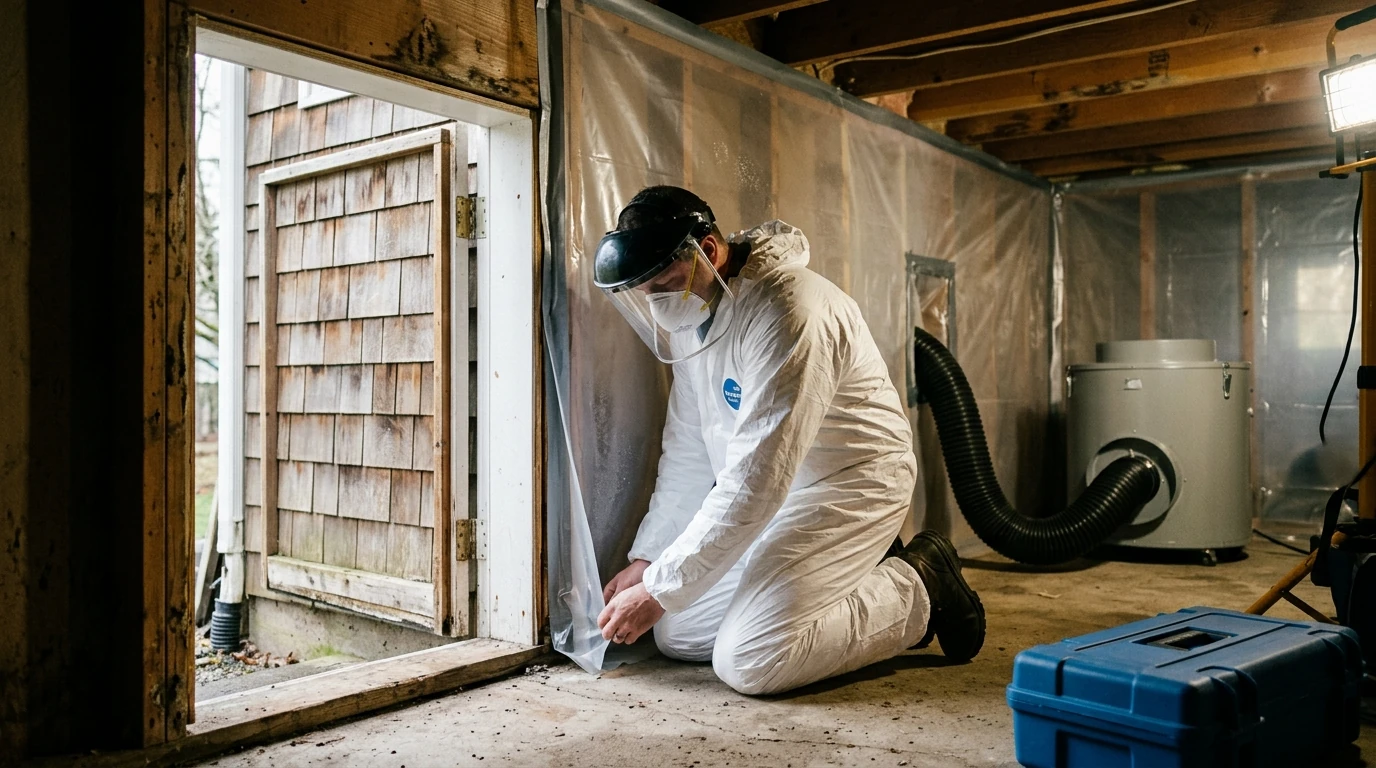
Containment and HEPA air filtration keep mold spores from spreading into the rest of your home while the affected area is being worked on. Without it, disturbing moldy drywall or insulation can push spore counts up throughout the house, not just in the room where the problem started.
Proper containment means sealed poly sheeting with a zipper entry, often under negative air pressure, so air only moves one direction: into the containment, through a HEPA filter, and out. A HEPA air scrubber running inside that containment captures airborne spores down to 0.3 microns while the crew works.
If a company proposes to “just spray it and leave the fan running” with no physical barrier between the work area and the rest of the house, that’s a shortcut, not a standard practice. The EPA’s guidance on mold cleanup is explicit that containing the work area is part of doing the job correctly, not an optional upsell.
Why is finding and fixing the moisture source more important than killing the mold?
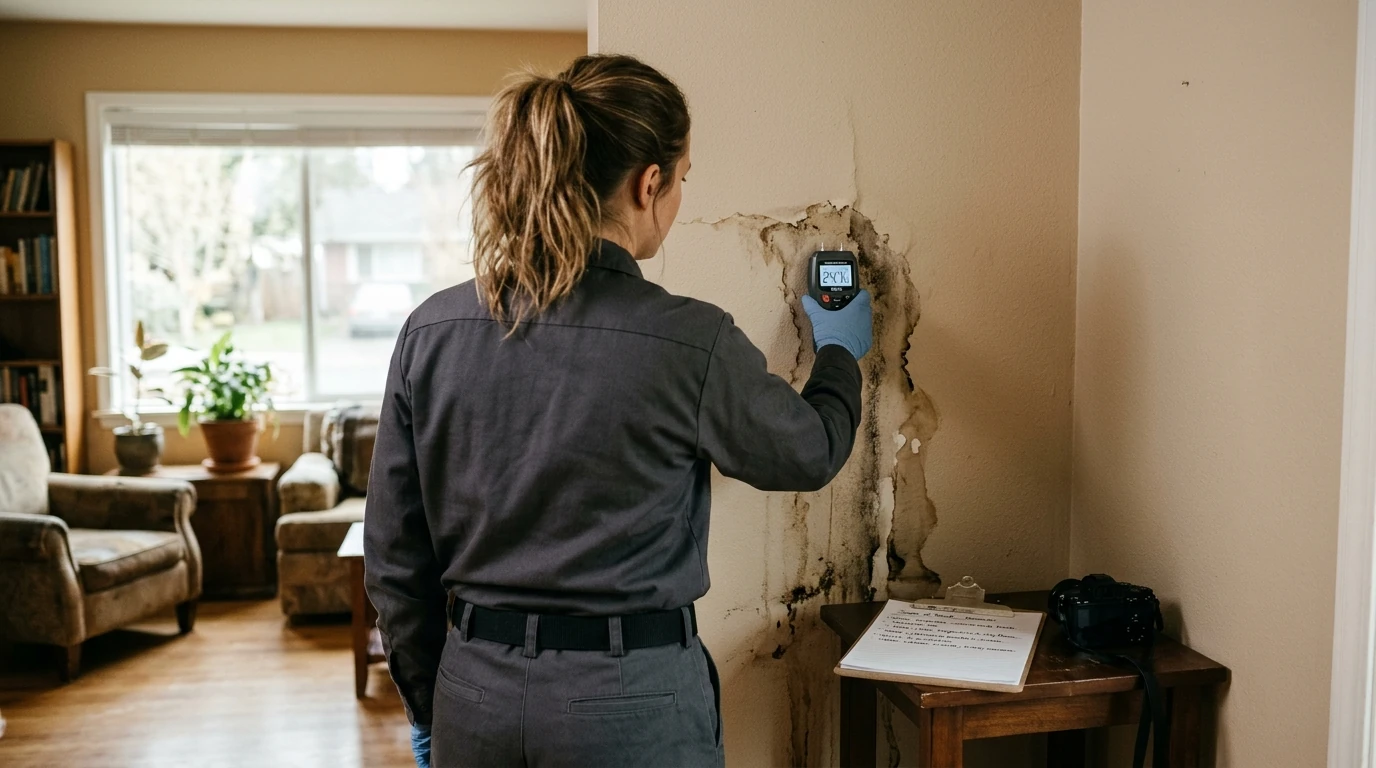
Mold returns within days if the water source that caused it isn’t found and repaired, no matter how thoroughly the visible growth was removed. Mold needs a continuous moisture source to come back, and the EPA notes mold can begin growing on wet material within 24 to 48 hours.
A company focused only on the mold itself, rather than the leak, the grading issue, the failed crawlspace vapor barrier, or the condensation problem behind it, is treating a symptom. Ask any company bidding the job: “What’s your plan for finding and fixing the moisture source, and who does that repair?” If mold showed up after a plumbing leak or roof intrusion, that’s a water damage question as much as a mold question; see our water damage restoration services for how that side of the job typically gets handled.
If the company can’t answer that question with specifics, specifically where they think the moisture is coming from and how they’ll confirm it’s fixed, keep asking.
What is post-remediation clearance testing and why insist on it?
Post-remediation clearance testing is an independent inspection, done after the remediation work is complete, that confirms spore counts and visible conditions in the work area have returned to acceptable levels before containment comes down. It’s the only objective proof the job actually worked.
Clearance testing should ideally be performed by a third party, not the same company that did the remediation, to avoid any conflict of interest. It typically involves a visual inspection plus air or surface sampling compared against conditions outside the work area. The EPA’s page on mold testing and sampling explains how this kind of sampling is used to verify a space is clear, not just to diagnose a problem.
A company that offers to “just seal it up when we’re done” with no clearance step is asking you to take their word for it. Insist on a pass/fail clearance result before you sign off and before any rebuild work (drywall, paint, flooring) starts back up.
What questions should you ask before hiring a mold company in Talent?
Before signing anything, ask these five questions and expect direct answers, not reassurance:
- Is your firm an IICRC Certified Firm, and is the technician on my job AMRT certified?
- Will I get a written scope of work before any demolition or treatment starts?
- What containment and HEPA filtration will be used, and will I see it set up before work begins?
- What’s your plan for identifying and fixing the moisture source, not just the mold?
- Who performs clearance testing when the job is done, and is it independent of your crew?
If a company can’t give you a straight answer to all five, that’s useful information too.
Swept Away Restoration has served Talent and the surrounding Rogue Valley since 2018, and walks through each of these five points with homeowners before any work starts. If you’d rather start with an inspection than a full remediation bid, our mold inspection and testing service is built for exactly that, confirming what you’re dealing with before anyone opens a wall.
Finding mold in your home is stressful, but the decision of who removes it doesn’t have to be a guessing game. Run any company you’re considering through the checklist above, and you’ll know within one phone call whether they’re doing this the right way.
About Swept Away Restoration
Swept Away Restoration is an IICRC Certified Firm (license #242626) founded in 2018, with offices in Talent and Ashland serving the Rogue Valley, including Phoenix, Medford, Jacksonville, and the surrounding Jackson County communities. Their technicians hold the IICRC AMRT (Applied Microbial Remediation Technician) and WRT (water damage) credentials and answer calls 24/7. This post was prepared with input from Joanna Rufo and the Swept Away Restoration team.
Need help now? Call Swept Away Restoration at (541) 821-3664.